
From the source material
1 / 1
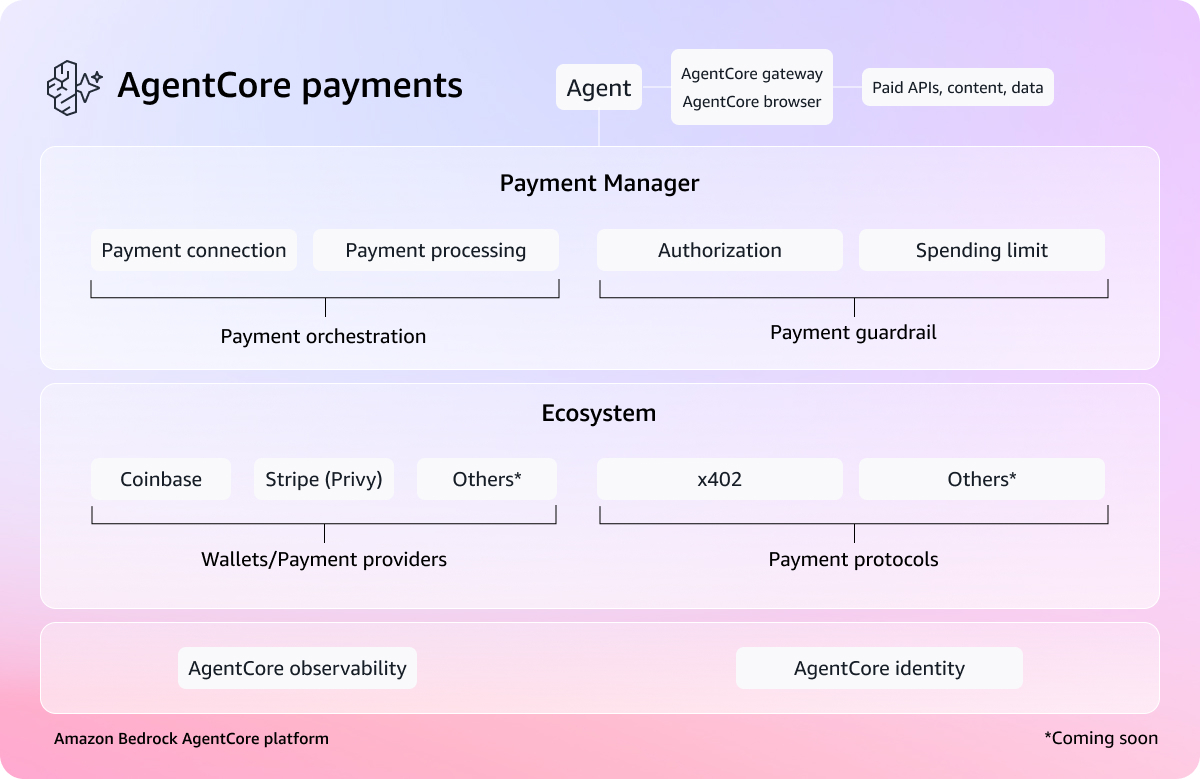
AWS is putting payment orchestration, wallet connections, authorization, spending limits, identity, and observability into the same AgentCore control plane. (Image: AWS)
Amazon has started giving AI agents a way to pay for things, which is exactly the kind of sentence that should make product teams excited and security teams reach calmly for the good coffee. In AWS’s announcement of Amazon Bedrock AgentCore Payments, the company says the preview lets agents access and pay for web content, APIs, MCP servers, and other agents, with Coinbase and Stripe providing the first wallet and payment infrastructure. That is the launch. The actual story is whether agent commerce can be made boring enough to trust.
Until now, most agent workflows have treated paid resources like an awkward human handoff. The agent can find the data, discover the API, or hit the paywall, and then someone has to wire up billing, credentials, policies, and monitoring like it is 2014 with more acronyms. AWS is pitching AgentCore Payments as the managed layer for that mess: connect a wallet or payment provider, register a funded source, set spending limits per session, and let AgentCore handle credential authentication, protocol negotiation, retries, payment, and traceability while the agent continues its task.
That matters because agents are becoming less like chat windows and more like tiny workflow engines with appetites. A financial research agent may need a paid market feed for one query. A coding agent may need a specialized paid MCP server, a private registry check, or a sandboxed tool call. A browser agent may run into a paywalled page that is willing to charge machines by the request. If every one of those requires a bespoke billing relationship, the agent economy does not scale. It becomes a procurement-themed escape room.
AWS’s first preview use case is micropayments, especially transactions under $1 or fractions of a cent. The payment flow is built around x402, an HTTP-native protocol that uses the 402 Payment Required status code. In AWS’s version, when an agent requests a paid endpoint and receives a payment-required response, AgentCore Payments authenticates with the configured wallet, executes the stablecoin payment, attaches proof, and returns the paid content to the agent. Coinbase’s x402 Bazaar MCP server is also being made available through AgentCore Gateway so agents can discover x402 endpoints rather than relying only on hardcoded integrations.
Translation: AWS is trying to make paid machine-readable resources feel like callable tools. Not free. Not magical. Callable.
The leash is the important part. AWS says users must explicitly authorize an agent to use a wallet, spending limits are enforced per session, and transactions are observable through the same logs, metrics, and traces developers already use for AgentCore behavior. The Amazon Bedrock AgentCore Payments documentation also says the preview stores sensitive wallet credentials through AgentCore Identity, integrates with Coinbase CDP and Stripe Privy for embedded stablecoin wallet operations, and exposes logs and traces through CloudWatch and X-Ray. That is the right shape of product. If an agent can move money, “trust me bro” is not an architecture.
Still, this is a preview, not a permission slip to let an agent roam the internet with a corporate card and a dream. AWS’s own docs warn that preview features and APIs may change before general availability. More importantly, the hard problems are not only technical. Who decides which merchants are acceptable? What happens when a paid endpoint returns junk? Can users understand what they authorized, or did they click a consent screen because the demo was late? How are refunds, disputes, tax treatment, audit requirements, stablecoin exposure, and regional compliance handled when the buyer is an agent acting on behalf of a person or business? The launch gives developers a control plane. It does not delete governance.
For practical teams, the near-term use case is not “my agent books the whole vacation while I nap.” Please do not start there. Start where the dollar amounts are small, the business value is obvious, and failure is containable: pay-per-use data lookups, research sources, niche APIs, controlled MCP tools, or internal experiments where a session budget can be capped hard. Require explicit user authorization. Set low default limits. Log every transaction. Treat paid endpoints like dependencies, not vending machines. And if the agent can retry automatically, make sure it cannot retry its way into a tiny but humiliating invoice.
The Coinbase and Stripe partnerships are the reason this story is bigger than another AWS feature tile. Coinbase brings the x402 and stablecoin infrastructure that fits machine-to-machine micropayments. Stripe, through Privy, gives AWS a path toward broader wallet and commerce infrastructure, with AWS saying fiat support and wider commerce flows are on the roadmap. That points to the larger ambition: not just agents buying data from APIs, but agents eventually booking flights, reserving hotels, buying goods, or paying other agents inside governed workflows. Wonderful. Also: yikes, if the guardrails are vague.
Useful Machines readers should watch this because payment is one of the missing pieces between impressive agent demos and agents that can actually complete work. An assistant that can research but not access the needed paid source stalls. An agent that can access paid sources but cannot be audited becomes a liability. The interesting middle is an agent with a narrow wallet, a visible receipt trail, a revocable permission model, and enough spending controls that finance does not learn about the experiment from the bank statement.
So yes, AWS gave agents a wallet. The useful question is whether it also gave developers enough leash, logs, and kill switches to keep that wallet from becoming a security incident with better branding. Agent commerce is probably coming because the web is already full of paid data, paid tools, and paid access. The winners will not be the systems that let agents spend the fastest. They will be the systems that make spending legible, bounded, reversible where possible, and boring enough for grown-up software. Boring, in this case, would be excellent news.
In short
Amazon Bedrock AgentCore Payments brings Coinbase, Stripe, x402, budgets, and observability into agent workflows. The useful question is not whether agents can pay — it is who controls when they are allowed to.