
From the source material
1 / 1
Generative infrastructure has a hidden tax: retries. Explicit tags eliminate them.
Google launched Gemini 3.1 TTS last week, and the headline feature is the introduction of explicit audio tags. Starting with an `[awe]` tag, developers can now directly manipulate vocal delivery, style, and pacing within a text prompt, bypassing the model's natural inclination to guess the speaker's emotional state from context.
Features are easier to demo than margin pressure. That does not make them the real story.
The real story is the economics of compute. For the last year, voice models have operated as opaque engines of expressive talent. You handed them a paragraph, and you hoped the latent space correctly inferred the emotional weight of the words. If a model read a legal disclaimer with the breathless enthusiasm of a sports broadcaster, your only recourse was to rephrase the prompt and try again.
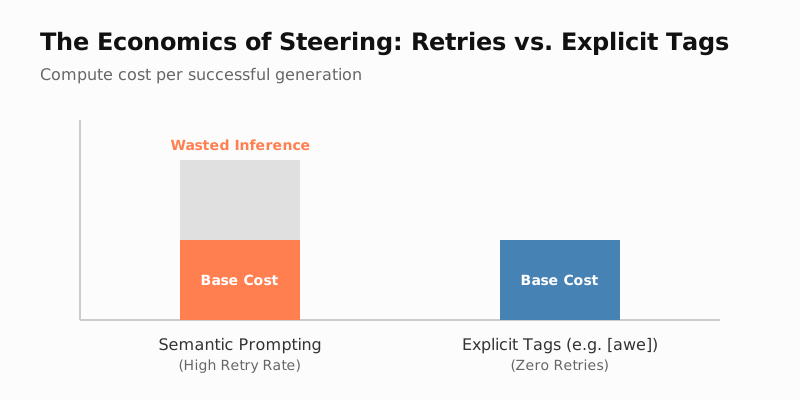
Retries are the hidden tax of generative infrastructure. At enterprise scale—processing millions of customer service interactions or generating thousands of audiobook hours—rerunning inference because the pacing was slightly off isn't just an annoyance. It is a measurable destruction of margin.
By moving from probabilistic guessing to deterministic steering, Google is acknowledging a hard truth about enterprise AI: predictability is more valuable than creativity. The new audio tag syntax shifts the burden of interpretation away from the raw model. The model no longer needs to spend compute cycles analyzing the semantic depth of a sentence to decide how fast to read it. The developer simply tells it.
This changes the cost equation. When a developer can force a specific cadence or tone on the first pass, they eliminate the retry loop. The total cost of operating the text-to-speech system drops, and the latency of building voice-first agents improves.
Competitors have built incredible expressive range into their audio models, but programmatic steering remains a chaotic art. You often have to prompt them like actors: "Read this as if you are a calm professional delivering bad news." That approach is brittle. It breaks across languages, and it degrades when the context window shifts.
Google's choice to build a formal syntax for vocal control suggests they understand that developers do not want temperamental actors in the datacenter. They want programmable components. If Google can establish this inline tag structure as a reliable standard, they create a sticky platform dependency. A developer who builds an entire application logic around Gemini's specific audio tags will find it much harder to swap in a cheaper open-weight model later.
What changes in practice is how teams should approach voice generation. Stop relying on prompt engineering to manipulate tone. Start building robust tagging engines that map application state directly to audio tags. The expressive era of text-to-speech is ending. The programmatic era is here.
In short
The introduction of inline audio tags in Gemini 3.1 TTS isn't just a formatting trick. It is a fundamental shift from probabilistic guessing to deterministic steering, aimed directly at the hidden costs of inference.