
From the source material
1 / 1
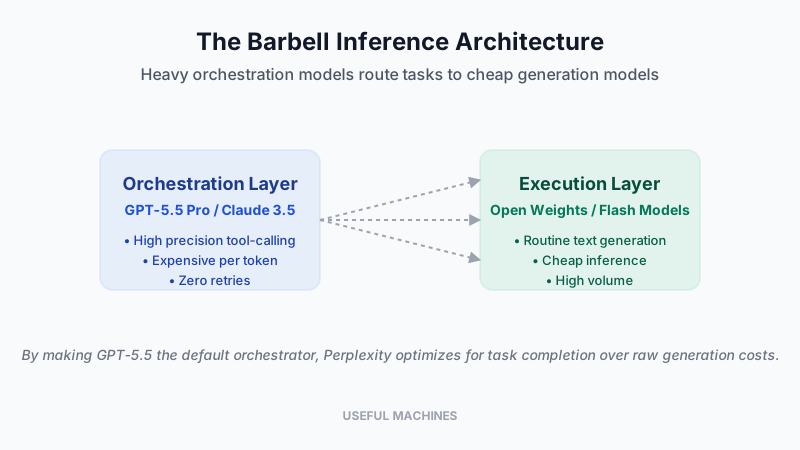
By making GPT-5.5 the default orchestrator, Perplexity optimizes for task completion over raw generation costs.
Perplexity just announced that GPT-5.5 is available for Max subscribers, which is the expected table stakes for any aggregator selling subscription access to frontier models. The interesting detail buried in the X announcement is the secondary rollout: GPT-5.5 is now the default orchestration model in "Computer" for both Pro and Max tiers. Features are easier to demo than margin pressure. That does not make them the real story. The real story is the decoupling of the brain that routes from the brains that generate.
When an AI application operates at Perplexity’s scale, it functions as a highly opinionated routing engine. A user asks a complex question, and the system must decide whether to search the web, run code, query an internal index, or delegate to a specialized sub-agent. This is the orchestration layer. For the last year, building an orchestration layer was an exercise in babysitting. Models would hallucinate tool inputs, get stuck in endless retry loops, or confidently plan a sequence of actions that logically contradicted each other.
By making GPT-5.5 the default orchestrator, Perplexity is acknowledging a structural shift in the economics of inference. The bottleneck for agentic systems is no longer raw intelligence or creative prose; it is the reliability of the tool-calling mechanism. Every time an orchestrator makes a mistake in calling an API or misinterprets a search result, it triggers a retry loop. Retries burn compute, inflate latency, and erode the margin of a fixed-price subscription. If GPT-5.5 can drastically reduce those retry loops, its higher per-token cost is actually cheaper per completed task.
This reveals the actual battlefield for the next generation of models. The consumer-facing output—the polished paragraph that answers the user's question—can increasingly be handled by cheaper, specialized models like Claude 3.5 Haiku or DeepSeek V4 Flash. But the hidden planning phase requires maximum precision. We are moving toward a barbell architecture where a heavy, expensive model plans the work, delegates it to a fleet of cheap open-weight models, and then steps back to evaluate the result.
The fact that Perplexity deployed this to their "Computer" feature—their environment for deeper, agentic task execution—underscores the point. When you give a system access to local or complex environments, the blast radius of a bad tool call increases. You cannot afford an orchestrator that guesses.
What changes in practice is how builders should approach multi-model architectures. Stop trying to find one model that handles both the thinking and the typing. Pay the premium for GPT-5.5 at the router level where precision prevents catastrophic latency, and ruthlessly optimize costs on the generation side. The market structure of AI is stratifying into management and labor layers. Perplexity just showed us who gets the management job.
In short
Perplexity is deploying GPT-5.5 as the default orchestrator for its agentic tier. It proves the next phase of AI architecture is a barbell: heavy routers delegating to cheap generators.